
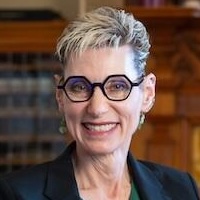
Marlene Tromp Appointed President of the University of Vermont

Marlene Tromp has been named the twenty-eighth president of the University of Vermont. She will officially begin her tenure this summer.

According to the most recent federal information, the University of Vermont enrolls over 12,000 undergraduate and 2,100 graduate students. Women represent almost two-thirds of the undergraduate student population.

Since 2019, Dr. Tromp has served as president of Boise State University in Idaho. Over the course of her tenure, the university has increased student enrollment, experienced record-breaking graduation rates and philanthropic funding, expanded research opportunities, and forged new community partnerships. Prior to her career with Boise State, Dr. Tromp served as provost and executive vice president of the University of California, Santa Cruz; vice provost and dean of the New College of Interdisciplinary Arts and Sciences at Arizona State University; and chair of women’s studies and chair of the faculty at Denison University in Granville, Ohio.

In addition to her administrative roles, Dr. Tromp teaches as a professor of English and women’s studies. As a scholar, she examines Victorian literature and culture and its relationship to current society. She has authored and edited several books throughout her career, most recently Untold Titanic: The True Story of Life, Death, and Justice (BookBaby, 2012).

“I came to Vermont with a clear feeling for UVM’s strength in research, its focus on student success, and the fulfillment of its land grant mission to Vermont and the nation,” said Dr. Tromp. “This is a university that has the power to truly lead the nation and even the world on several fronts, and I’m so excited to work with my colleagues, the students, alumni, and friends to improve individual lives and the life of the community.”

Dr. Tromp received her bachelor’s degree from Creighton University in Omaha, Nebraska, a master’s degree from the University of Wyoming, and a Ph.D. from the University of Florida.

LEAVE A REPLY

Please enter your comment!
Please enter your name here

This site uses Akismet to reduce spam. Learn how your comment data is processed.

Related Articles

Latest News

Michelle R. Johnston Named the First Woman President of the University of Montevallo

Although it was initially founded as school for women, the University of Montevallo has never had a woman president. Now the university has reached a historic milestone and selected selected Michelle R. Johnston to serve as its next president.

Katy Ho to Lead Portland Community College in Oregon

Dr. Ho is the new acting president of Portland Community College. Prior to her new role, she was the college's executive vice president.

Five Women Scholars Selected to Lead Professional Organizations in Their Fields

The women who are taking on new leadership roles with professional academic organizations are Yasmeen Shorish of James Madison University in Virginia, Elena Carbone of the University of Massachusetts Amherst, Shelley Lusetti of New Mexico State University, Oona Hathaway of Yale Law School, and Keisha Blain of Brown University.

Katherine Yelick to Direct Lawrence Berkeley National Laboratory

Lawrence Berkeley National Laboratory is a national program run by the University of California for the U.S. Department of Energy's Office of Science. Dr. Yelick, a computer scientist and longtime UC Berkeley faculty member, will become the laboratory's next director on July 1.

Two Women Selected for Key Interim Leadership Roles with the Universities of Wisconsin

Renée Wachter, chancellor of the University of Wisconsin-Superior, has been selected to serve as interim president of the Universities of Wisconsin. Maria Cuzzo, provost of UW-Superior, will serve as the university's interim chancellor while Dr. Wachter assumes her new responsibilities.

President

The next president will lead one of the most successful and well-respected community colleges in the country.

Research Assistant Professor, Kenneth C. Griffin Department of Economics

The selected candidate should have expertise and experience in theoretical models in labor and public economics as well as in microeconometrics and programming.