
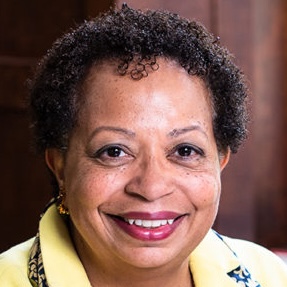
Trinity College President Joanne Berger-Sweeney Announces Retirement

Joanne Berger-Sweeney, president of Trinity College in Hartford, Connecticut, has announced her plans to retire in June 2025 at the conclusion of the next academic year.

Dr. Berger-Sweeney became the twenty-second president of Trinity College in 2014, making her the college’s first Black and first woman president since its founding in 1823. She also serves as a professor of neuroscience.

Over the past decade, Dr. Berger-Sweeney’s leadership has led to improved enrollment, retention, and graduation rates. The college has also hired more diverse faculty, expanded its undergraduate financial aid process, doubled its endowment, and made numerous infrastructure improvements since Dr. Berger-Sweeney assumed her presidency. She also oversaw the college’s largest fundraising campaign during her first three years in office, ultimately raising $70 million.

Prior to joining the Trinity College community, Dr. Berger-Sweeney spent four years as dean of the School of Arts and Sciences at Tufts University in Massachusetts, where she also served as a professor of biology, with additional appointments in psychology and public health and community medicine. Before Tufts University, she spent two decades with Wellesley College in Massachusetts, holding various positions including professor of biological sciences, director of the neuroscience program, and associate dean. She also held an additional appointment with Harvard University as a lecturer in the department of psychiatry for five years.

Dr. Berger-Sweeney is a graduate of Wellesley College where she majored in psychobiology. She holds a master of public health degree in environmental health sciences from the University of California, Berkeley and a Ph.D. in neurotoxicology from Johns Hopkins University in Baltimore.

1 COMMENT

  1. Joanne is one of this earth’s finest human beings. I send congratulations to her on a job well done.

LEAVE A REPLY

Please enter your comment!
Please enter your name here

This site uses Akismet to reduce spam. Learn how your comment data is processed.

Related Articles

Latest News

Michelle R. Johnston Named the First Woman President of the University of Montevallo

Although it was initially founded as school for women, the University of Montevallo has never had a woman president. Now the university has reached a historic milestone and selected selected Michelle R. Johnston to serve as its next president.

Katy Ho to Lead Portland Community College in Oregon

Dr. Ho is the new acting president of Portland Community College. Prior to her new role, she was the college's executive vice president.

Five Women Scholars Selected to Lead Professional Organizations in Their Fields

The women who are taking on new leadership roles with professional academic organizations are Yasmeen Shorish of James Madison University in Virginia, Elena Carbone of the University of Massachusetts Amherst, Shelley Lusetti of New Mexico State University, Oona Hathaway of Yale Law School, and Keisha Blain of Brown University.

Katherine Yelick to Direct Lawrence Berkeley National Laboratory

Lawrence Berkeley National Laboratory is a national program run by the University of California for the U.S. Department of Energy's Office of Science. Dr. Yelick, a computer scientist and longtime UC Berkeley faculty member, will become the laboratory's next director on July 1.

Two Women Selected for Key Interim Leadership Roles with the Universities of Wisconsin

Renée Wachter, chancellor of the University of Wisconsin-Superior, has been selected to serve as interim president of the Universities of Wisconsin. Maria Cuzzo, provost of UW-Superior, will serve as the university's interim chancellor while Dr. Wachter assumes her new responsibilities.

President

The next president will lead one of the most successful and well-respected community colleges in the country.

Research Assistant Professor, Kenneth C. Griffin Department of Economics

The selected candidate should have expertise and experience in theoretical models in labor and public economics as well as in microeconometrics and programming.