
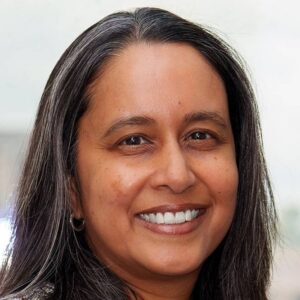
Princeton’s Mala Murthy Wins the Wiley Prize in Biomedical Sciences

Mala Murthy, director of the Princeton Neuroscience Institute and the Marnie Marcin ’96 Professor of Neuroscience at Princeton University, is a recipient of the 24th annual Wiley Prize in Biomedical Sciences from the Wiley Foundation. Dr. Murthy shares the award with Sebastian Seung of Princeton, John White of the University of Wisconsin-Madison, and Gerald Rubin of the Howard Hughes Medical Institute’s Janelia Research Campus for their combined work in “reconstructing and interpreting connectomes, the anatomical wiring diagrams of neurons and synapses that underlie how the brain processes information and controls actions.”

“The Wiley Foundation honors scientists who are dedicated to solving complex biological mechanisms which result in seminal discoveries that open the door for future innovations,” said Deborah Wiley, chair of the Wiley Foundation. “The work of the 24th Annual Wiley Prize recipients truly upholds this mission by helping us to understand how networks of neurons interact and communicate, offering a framework for diagnosing neurodegenerative diseases such as Alzheimer’s and Parkinson’s, as well as psychiatric illnesses such as schizophrenia.”

Dr. Murthy is a widely recognized expert on fruit fly neuroscience. More specifically, she studies the neural mechanisms underlying social communication in flies. In 2024, she and Dr. Seung completed the first complete brain map of the adult fruit fly, in collaboration with the international FlyWire community.

“I feel very humbled and honored by this prize,” said Dr. Murthy. “The big surprise to me is how quickly this achievement has been recognized. Usually it takes decades for something you’ve worked on to percolate through the field, for people to appreciate the utility of it. I think it speaks to how useful the connectome has been to fly research — not only to understand flies, but because solving how any brain processes sensory information, makes decisions, learns something, executes actions, is important. It’s clear now how a map of the brain can lead to fundamental discoveries about how brains work. And I think the fly field, which I’m very proud to be a part of, has made that very, very clear.”

A native of southeast Texas, Dr. Murthy received her bachelor’s degree in biology from the Massachusetts Institute of Technology and her Ph.D. in neuroscience from Stanford University in California.

LEAVE A REPLY

Please enter your comment!
Please enter your name here

This site uses Akismet to reduce spam. Learn how your comment data is processed.

Related Articles

Latest News

Tawny Dotson Named the First Woman President of Mt. San Jacinto College

Dr. Dotson spent six years as president of Yuba College in California. Earlier, she served eight years as a senior administrator with Clover Park Technical College in Washington.

Duke University’s Svati H. Shah to Lead the American Heart Association

Dr. Shah is the Ursula Geller Distinguished Professor of Research in Cardiovascular Diseases and associate dean for translational research at the Duke University School of Medicine. She will serve as president-elect of the American Heart Association in 2026–2027, followed by a one-year term as president in 2027–2028.

Melissa Batten to Lead Horry-Georgetown Technical College in South Carolina

Dr. Batten will become interim president of Horry-Georgetown Technical College on August 1. She most recently served as the two-year college's vice president for student affairs.

Leamor Kahanov Appointed President of Notre Dame de Namur University

Dr. Kahanov became the twentieth president of Notre Dame de Namur University in California on July 1. She previously served as provost at Alvernia University in Pennsylvania, Stockton University in New Jersey, and SUNY Oneonta.

Jennie Sanders to Lead Academic Affairs at Purdue Global

Most recently, Dr. Sanders served as vice president of experiential product management and interim vice president of product and technology at Western Governors University.

Pediatric Gastrointestinal/Liver Pathologist – Assistant Professor – Clinician Educator Track (CHOP)

Children's Hospital of Philadelphia and the Department of Pathology and Laboratory Medicine at the Perelman School of Medicine at the University of Pennsylvania seek candidates for an Assistant Professor position in the non-tenure clinician educator track. Expertise is required in the specific area of gastrointestinal and liver pathology.

Pediatric Gastrointestinal/Liver Pathologist – Associate Professor – Clinician Educator Track (CHOP)

Children's Hospital of Philadelphia and the Department of Pathology and Laboratory Medicine at the Perelman School of Medicine at the University of Pennsylvania seek candidates for an Associate Professor position in the non-tenure clinician educator track. Expertise is required in the specific area of gastrointestinal and liver pathology.

Pediatric Gastrointestinal/Liver Pathologist – Assistant Professor – Academic Clinician Track (CHOP)

Children's Hospital of Philadelphia and the Department of Pathology and Laboratory Medicine at the Perelman School of Medicine at the University of Pennsylvania seek candidates for an Assistant Professor position in the non-tenure academic clinician track. Expertise is required in the specific area of gastrointestinal and liver pathology.

Pediatric Gastrointestinal/Liver Pathologist – Associate Professor – Academic Clinician Track (CHOP)

Children's Hospital of Philadelphia and the Department of Pathology and Laboratory Medicine at the Perelman School of Medicine at the University of Pennsylvania seek candidates for an Associate Professor position in the non-tenure academic clinician track. Expertise is required in the specific area of gastrointestinal and liver pathology.

Tenure-Track Assistant Professor of Computer Science

Haverford College invites applications for a tenure-track position as Assistant Professor in the Department of Computer Science, starting in Fall semester 2027. The area of scholarly expertise is open, with the successful candidate demonstrating evidence of research productivity, vision, and long-term impact in their field.