


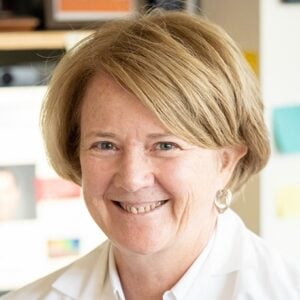
 Mary-Ellen Taplin, oncologist with Dana-Farber Cancer Institute and professor at Harvard Medical School, is the 2026 recipient of the Prostate Cancer Foundation (PCF) Women in Science Lifetime Achievement Award. The award recognizes women who have demonstrated extraordinary scientific achievement, leadership, and a lifelong commitment to advancing prostate cancer research and patient care.
Dr. Taplin is a genitourinary oncologist and internationally recognized expert in prostate cancer whose research has centered on how prostate cancer responds and adapts to hormone therapy. Her research and leadership in clinical trials have resulted in now standard-of-care treatments for advanced prostate cancer.
“When prostate cancer stopped responding to hormone therapy, Dr. Taplin asked why and then spent three decades turning the answer into treatments that are now standard of care,” said Gina Carithers, president and CEO of the PCF. “Men with advanced and high-risk disease are living longer because of her work. And the investigators she has trained, including 14 PCF Young Investigators, will carry that impact for decades to come. This is exactly the kind of science PCF exists to fund, and we are proud to honor her.”
Dr. Taplin received her medical degree and completed her residency in internal medicine at the University of Massachusetts. After completing a fellowship in hematology and oncology at Beth Israel Deaconess Medical Center, she spent a decade on the faculty of the University of Massachusetts. In 2003, she began her tenure with Harvard and Dana-Farber, where she currently serves as chair of the executive committee for clinical research.
“I am honored to receive this award,” said Dr. Taplin. “The questions I have worked on for three decades are not questions any one person answers alone. They have been answered alongside patients who enrolled in trials, colleagues and trainees who pushed the science further, and partners like PCF that were willing to fund the difficult, unglamorous work of understanding why treatments stop working. There is a great deal still to do, and I am encouraged by the next generation of researchers who will carry this work forward.”