


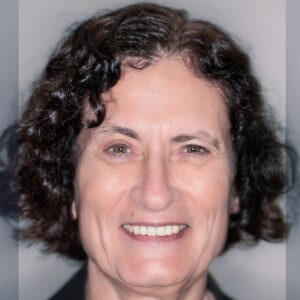
 Victoria Coleman, former chief scientist for the United States Air Force, has been named associate provost of the Berkeley Space Center at the University of California, Berkeley. In addition to overseeing the center’s broad research portfolio and operations, she will also hold a faculty appointment as a professor of electrical engineering and computer sciences at the university.
Announced in 2023, the Berkeley Space Center will be built on 36 acres leased from NASA’s Ames Research Center in Mountain View, California. The new center will house research space for companies interested in collaborating with UC Berkeley and NASA scientists and engineers to generate novel innovations in aviation and space exploration.
Dr. Coleman has nearly four decades of professional experience in government, industry, and academic settings. Her career began teaching computer science at the University of London. After a decade in academia, she moved to the United States to become founding director of the System Design Laboratory at SRI International, followed by a stint as founding director of the U.S. Department of Homeland Security’s Cyber Security Research and Development Center.
In 2020, following nearly two decades of progressive leadership positions with leading technology firms, Dr. Coleman was tapped to lead the Defense Advanced Research Projects Agency (DARPA) – the research and development arm of the U.S. Department of Defense. One year later, she was appointed to the U.S. Air Force as the thirty-seventh chief scientific adviser to the secretary of the Air Force, Air Force chief of staff, and chief of space operations. For the past year, Dr. Coleman has directed Airbus’s innovation center in Silicon Valley.
In her new faculty position, Dr. Coleman plans to lead her own research group in next-generation aerospace technologies with a focus on autonomy, resilience, and sustainability. She is particularly interested in microelectronics for mission-critical systems, software-defined space architectures, and sustainable space engineering practices, such as autonomous repair, in-orbit assembly, and debris management.
“I see immense opportunity at the Berkeley Space Center to unite the campus community working on space and discovery with innovators pursuing advanced aviation and autonomous transportation,” said Dr. Coleman. “Together, we can create a vibrant ecosystem where fundamental curiosity meets innovation in the national interest, ensuring that our work has impact from the lab bench to orbit and beyond.”
Dr. Coleman holds a Ph.D. from the University of Manchester in England.